Cozy desktop — the warm, light 'Your profile' page shown inside a dark browser-window frame, with a network sidebar, a public-facing profile of work aspects, a private verification panel, and a hold-to-speak voice capture card

Cozy: a relationship manager that keeps the context close

Cozy is a design prototype for a personal relationship manager: the people who matter to you, the context around them, and the next nudge, kept in one place. It came out of one of our design sprints, and it's a study in what agentic AI changes about software this personal. Speak a note and it files itself. Reminders arrive carrying reasons. Every surface tells you who can see it. This is a UX exploration from a sprint; nothing here is a shipped product.

Updated
July 12, 2026
Reading Time
7 min
Cozy — an interactive prototype. Click to open it live.

The catch-up comes first

More and more of what reaches me was written by software. LinkedIn posts that feel oddly dynamic, cold emails that quote my last three projects, agents replying to other agents. I don't think the fix is more automation on my side of the conversation. What's becoming scarce is the human part, and I notice how much I value it: on almost every call I take, I want to spend the first few minutes on the person. How was the vacation you were supposed to go on? Did the move happen? The business can wait five minutes.

The trouble is that remembering is work. The details that make those first five minutes real scatter across a texting app, a calendar, a notes app, and my own memory, and three months later I'm opening with a generic "how have you been?" Cozy is a design prototype we built to take on exactly that load. It remembers what matters about the people you know, so you can show up as someone who remembers. It isn't gamification, and there are no streaks to keep alive; the point is offloading the mental load, nothing else.

Everything below is design thinking from a sprint. The screens are real, the product is a prototype, and any names or numbers you see in them are sample data.

Why the details slip

The reason context slips is mundane. Capturing a detail costs about thirty seconds of attention right after a conversation, and those thirty seconds rarely happen; the note you meant to keep evaporates on the walk to the next meeting. Whatever does survive lands in tools that weren't built for the job. A contacts app stores phone numbers and birthdays. A CRM wants a deal stage. A notes app will hold anything and find nothing.

So the design brief for Cozy reduces to three requirements. Keep the person, the context, and the next nudge in one place you'd actually open. Make capture cheap enough that it fits inside those thirty seconds. And let the software do some of the remembering for you, by telling you who's drifting and why reaching out is worth it.

Speak once, and it files itself

The capture card sits in the right rail of every screen: "Hold to speak," a microphone, a hint to hold the space bar, and a fallback field that reads "Or type a quick note…" You say the thought while it's warm, walking out of the meeting or sitting in the car, and you're done. That's the entire ask the product makes of you.

What happens next is where agents earn their place in this design. The app files the note itself: it routes the thought to the right person and the right strand of attention, creating those strands as it goes. Each person's profile organizes what you know into a few named aspects with plain-spoken headlines and a running note count. Above them sits an AI summary marked "synthesized from your notes," and each line of it traces back to a real entry, yours or one someone shared with you, so you can check where a claim came from.

There's also a private journal for the notes meant for no one, with a capture prompt that promises "just for you." The app reads it to keep your profiles current and never surfaces it. The division of labor runs the same way through the whole prototype: the software drafts, files, summarizes, and reminds, and the judgment about who matters stays with you. It's the approach to agentic software we lay out once, properly, in the essay on the model behind AI Hero: design the product around what agents do well, and keep the person in charge of the decisions.

A nudge that carries a reason

Reminders are where tools like this usually turn sour, so the design gives every nudge a reason you can read. One is a promise you made: "you said you'd send the deck." One is a rhythm you set: "it's been four months; you'd wanted quarterly." One is an event worth marking: "their talk is in eight days." You can act on the reason or let it pass.

Two choices keep this from becoming nagging. Cadence is set per person, weekly for the collaborator you're mid-project with, quarterly for the occasional contact, "as it arises" for everyone else, so drift is measured against your own intent. And the "Top of mind" list in the left rail states elapsed time plainly: six days, five weeks, four months. It surfaces the people who are drifting rather than the ones you already talk to every day, because drift is the failure that actually costs you people.

A four-month gap gets mentioned the way a thoughtful friend would mention it: once, and then the decision is yours.

Every surface says who can see it

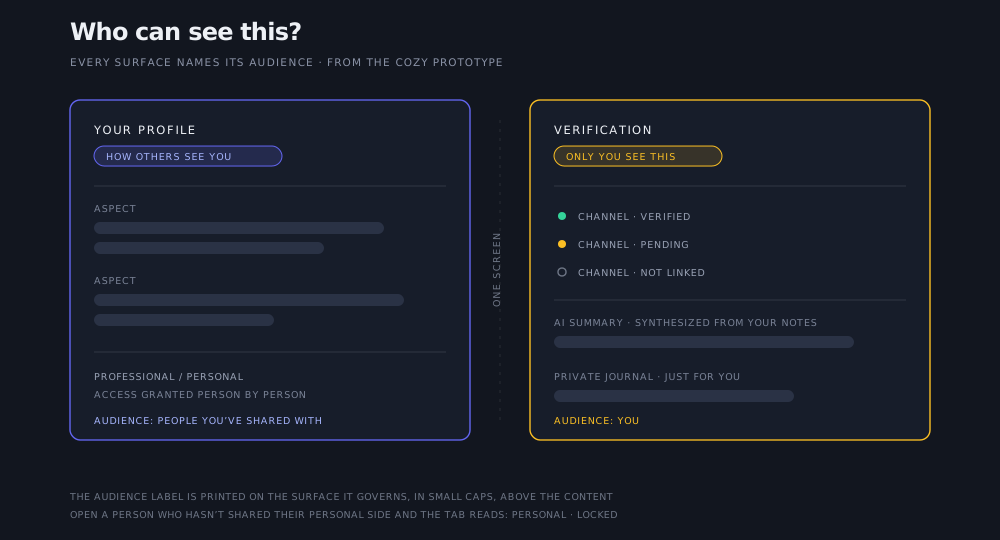
A product built out of private notes about other people has one design question above all the rest: who else can see this? Cozy's answer is to print the audience on the surface itself, in small caps, above the content it governs. The profile reads "YOUR PROFILE · HOW OTHERS SEE YOU." The verification panel beside it reads "VERIFICATION · ONLY YOU SEE THIS." The AI summary carries the same byline. In most apps privacy is a control you go find; here it's a caption on everything you read.

Two panes from one Cozy screen: the profile labeled 'how others see you' and the verification panel labeled 'only you see this,' each with its audience printed on the surface it governs.

The two-audience model. The audience label is printed on the surface it governs; Professional/Personal access is granted person by person.

The boundary goes deeper than the labels. Every person has a Professional and a Personal dimension, and you grant access to each one person by person. A work contact might see only your professional side. Open someone who hasn't shared their personal side with you and the tab reads "Personal · locked." The same rule shapes what you see of others: someone you know renders as your own noted-up synthesis, while someone new to you shows only their public face.

This matters because trust in a product like this is won moment to moment. If a user is ever unsure whether a private note could become public, they stop writing notes, and the product starves. Naming the audience inline settles the question before it forms.

What it leaves out, and where it could fail

The design refuses some obvious features on purpose. There's no outreach automation, because software that sends warm messages for you would turn tended relationships into mail merge. There's no scoring and no leaderboard of the people you know. The AI drafts, summarizes, files, and reminds, and every actual reach-out is something you chose to do.

The honest caveats, since this is a sprint prototype and the thinking is the point: a louder product would save some relationships that a gentle, information-only nudge lets lapse. And the synthesis is only as good as what gets captured, so the whole idea rests on capture staying as cheap as the design imagines. Both are questions we'd want a pilot to answer.

Visually, Cozy wears a warmer, softer face than the work tools built on the same design system, which is the right signal for a product that lives in your personal life. And the measure of success is small and human: three months from now, you open with a question about the trip they were about to take, and the catch-up feels like it never lapsed.

Article by

Rahul Parundekar

Rahul Parundekar

San Francisco-based consultant specializing in cutting-edge Generative AI (GenAI). I partner with organizations to pinpoint high-impact opportunities, streamline AI operations, and accelerate the launch of innovative products—efficiently, cost-effectively, and with controlled risk. Founder of Elevate.do and A.I. Hero, Inc.