The North prototype's strategy-map screen: objective cards by function with on-track and at-risk status pills, owners, and proving metrics

North: making strategy something you can operate

Quarterly OKR reviews were built for work done at human speed. Once agents do part of the work continuously, leaders need two new things: direction people can follow week by week, and a check that the work agents produce still serves the plan. North is our sketch of that surface. Every piece of work, human or agent, rolls up through function KPIs into the company’s objectives, agents keep the messy planning inputs reconciled, and people keep every decision. If you run strategy or operations, this walkthrough should leave you with a concrete picture of what an operable plan could look like.

Updated
July 12, 2026
Reading Time
8 min
North — an interactive prototype. Click to open it live.

The deck dies faster now

There is a specific kind of quiet that settles over a strategy deck about three weeks after the offsite. The slides were good, the room agreed, and then the deck went into a shared drive while the quarter started without it. The plan lives in slides, the numbers live in a BI tool, and nobody can say on a Tuesday whether the strategy is working. That was the situation when every piece of work was done by a person. It gets worse from here, because agents don’t wait for the quarterly review. Work done by agents lands continuously: churn data reconciled overnight, reports drafted between meetings, tickets triaged before anyone logs in. A plan that gets compared with reality four times a year has never gone stale this fast.

North is our probe at that problem. To be clear about what it is: sprint work, with a fictional company’s plan on its screens as placeholder data. Every number in this walkthrough, including the $40M ARR objective below, is sample data. The question the prototype chases is real, though. What does strategy software look like when the plan has to stay connected to work that never stops?

Quarterly reviews assume human-paced work

The OKR ritual has a hidden assumption: work arrives at human speed, so checking the plan once a quarter is enough. AI transformation breaks that assumption from two sides. From one side, people need more direction than a quarterly review provides. Working alongside agents means deciding, week by week, what to delegate, what the numbers mean, and what good looks like, and that guidance has to be available when the question comes up. From the other side, the work agents produce needs checking against intent. An agent that reconciles churn data every night is executing somebody’s reading of the strategy, and whether its output actually serves the objectives is a question a person has to be able to answer. Most companies have no surface where that question can even be asked. In the terms we used in The Tideline, this is the verify-impact stage of the arc, and it stays human.

What leaders need, then, is one place where direction flows down and evidence rolls up: objectives that people and agents can both work from, and a live read on whether all of the work is moving the numbers the company committed to.

The KPIs you used to hire consultants for

Building that read used to be a consulting engagement. You hired a firm to run workshops, define the KPIs, and wire up dashboards, and the result stayed current for about as long as the org chart that commissioned it. With agentic AI, defining the plan becomes conversational. In the prototype the primary action is Draft a goal, by voice. Say the commitment the way you’d phrase it in a leadership meeting, “we want to reach forty million in ARR by the end of the year, mostly new-logo bookings, and VP Revenue owns it,” and the software drafts the structured objective, the metrics that would prove it, and the owner. Then it stops. Nothing is saved until a person approves it.

The same reconciliation runs on the messy inputs a real plan is made of. A strategy is never one document; it’s a 32-slide board deck, an annual planning memo, a Slack thread, and a voice note from the offsite, all disagreeing slightly. North reads each one, maps every commitment back to the model, and surfaces the conflicts instead of quietly picking a winner. The deck commits to $40M ARR while the leadership thread settled on $38M, so the screen asks the only question that matters: which is the plan? The agent does the reading and the structuring. The human keeps every decision.

Every piece of work rolls up

The home screen is the strategy map: the mission at the top, stated as a commitment, and one card per function underneath, each carrying an objective, the title accountable for it, and the metrics that would prove it. Each metric also names the system its number comes from. Recurring revenue reads from billing, uptime from monitoring, retention from the customer survey. The map stays the record of what’s committed and who’s accountable; it doesn’t try to be one more dashboard someone has to keep green.

The part built for an agentic company is the rollup underneath the cards.

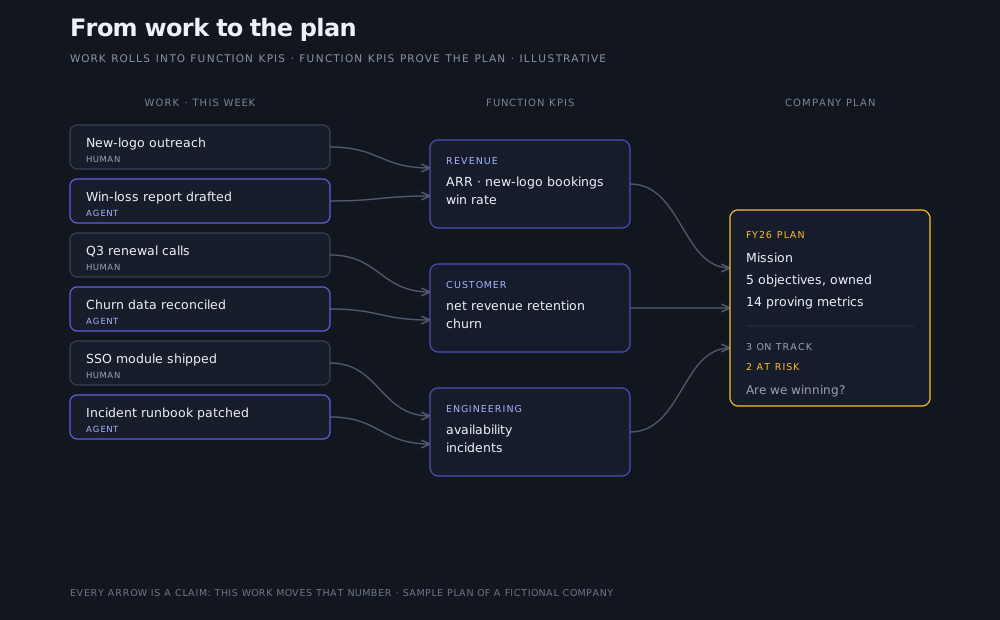
Flow diagram: six work items, three by humans and three by agents, feed three function KPI groups (revenue, customer, engineering), which roll up into one company plan of five objectives and fourteen proving metrics.

The rollup, on the prototype's sample plan: work items feed function KPIs, and function KPIs prove company objectives. Every arrow is a claim that this work moves that number.

A renewal call made by a person and churn data reconciled by an agent land in the same place: the customer function’s KPIs, which in turn prove a company objective. When an agentic deployment takes over intake triage, its throughput and error rate join the same tree. That’s the design answer to the observation this prototype started from. Once a growing share of the work is done by agents, the company needs to see all of the work, human and agent, in one structure that ties it to the long-term objectives, function by function, deployment by deployment, up to the plan.

The discipline that keeps the map honest

An objective with no owner is a wish, and an objective with no metric is an opinion. North refuses to render either one.

Two smaller decisions do quiet work in the same direction. Every metric carries its direction of good: time to first value shows a down arrow because shrinking it is the win, and the sample plan’s most opinionated metric, spreadsheet exports per account, points down at zero because the fictional mission promises to “replace the spreadsheets in between.” The fastest way to lie to yourself about a mission is to never measure the thing it promised. Objectives that are standards rather than projects, like 99.95% availability, are marked Ongoing instead of being forced onto a due date. And the map shows two of the five sample objectives at risk, plainly, at the top of the screen, rather than averaging them into a comforting composite score.

Are we winning, and how do we know?

The office of strategy, the one to three people who own the plan but none of the work, spends most of its time today chasing updates and rebuilding the board deck. The point of a tool like North is to give that role, and the CEO behind it, a plain read instead of a monthly ritual. It’s also the kind of software we’d build as bespoke SaaS, shaped around one company’s plan and vocabulary and changed weekly as the plan changes.

If agents already do part of your team’s work, try the prototype’s core question on your own company some random Tuesday: are we winning, and how do we know? If answering takes four tools and a meeting, that gap is what this design was built to explore.

References

Article by

Rahul Parundekar

Rahul Parundekar

San Francisco-based consultant specializing in cutting-edge Generative AI (GenAI). I partner with organizations to pinpoint high-impact opportunities, streamline AI operations, and accelerate the launch of innovative products—efficiently, cost-effectively, and with controlled risk. Founder of Elevate.do and A.I. Hero, Inc.